
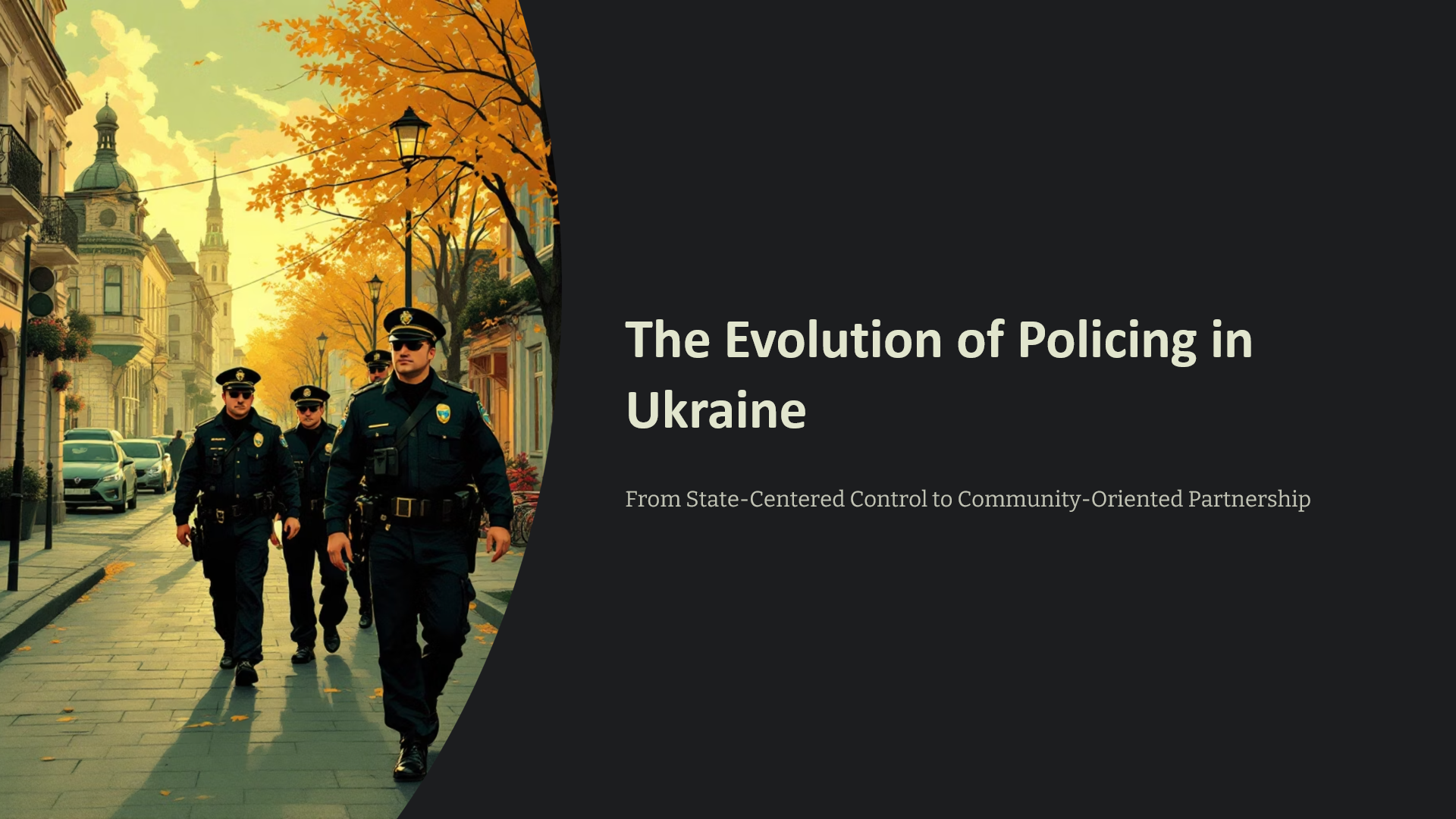
What is Community Policing?- A tactical innovation, or a new social contract between citizens and the state?
In post-authoritarian societies like Ukraine, this question is not merely academic. It cuts to the core of how legitimacy is rebuilt after decades of state-centered control. This write-up traces the evolution of policing in Ukraine from the Soviet Militsiya — an institution designed to dominate rather than serve — to a community-oriented model increasingly defined by trust, partnership, and mutual accountability.
Following the Revolution of Dignity (2013–2014), Ukraine launched an ambitious police reform in 2015, replacing the Militsiya with the new National Police. As scholars like Friesendorf (2019) and Pehlman (2020) show, this transformation was neither linear nor complete. It functioned as institutional bricolage — selectively combining Western democratic policing frameworks with existing post-Soviet structures. While the new Patrol Police became a visible symbol of change, deeper investigative and management units often retained old practices, reflecting ongoing struggles between reform ambitions and entrenched bureaucratic interests.
A critical turning point came with the Community Police Officer (CPO) project, launched in 2018. By embedding officers permanently in local communities — particularly rural hromadas — the project shifted policing from centralised enforcement to localised partnership. Officers became not just law enforcers but trusted members of their communities, co-producing security with residents and local authorities. This model, as Bespalova (2020) and Holub (2020) argue, represents a genuine operationalisation of democratic policing principles, building what can be called a localised micro-social contract.
Then everything changed. Russia’s full-scale invasion in 2022 thrust the National Police into unprecedented roles: territorial defence, evacuation coordination, humanitarian corridor protection, and war crimes documentation. As Buhaichuk (2025) and Yuliia (2025) document, these extreme conditions did not merely add new tasks — they accelerated the transformation of community policing from an idealistic reform into a mechanism of societal survival. Crucially, Friedrich’s (2024) field research reveals that police effectiveness in de-occupied and frontline areas depended less on formal authority than on the quality of relationships built before the invasion. Where community policing principles had taken root, trust became a force multiplier. Where they had not, vulnerabilities emerged.